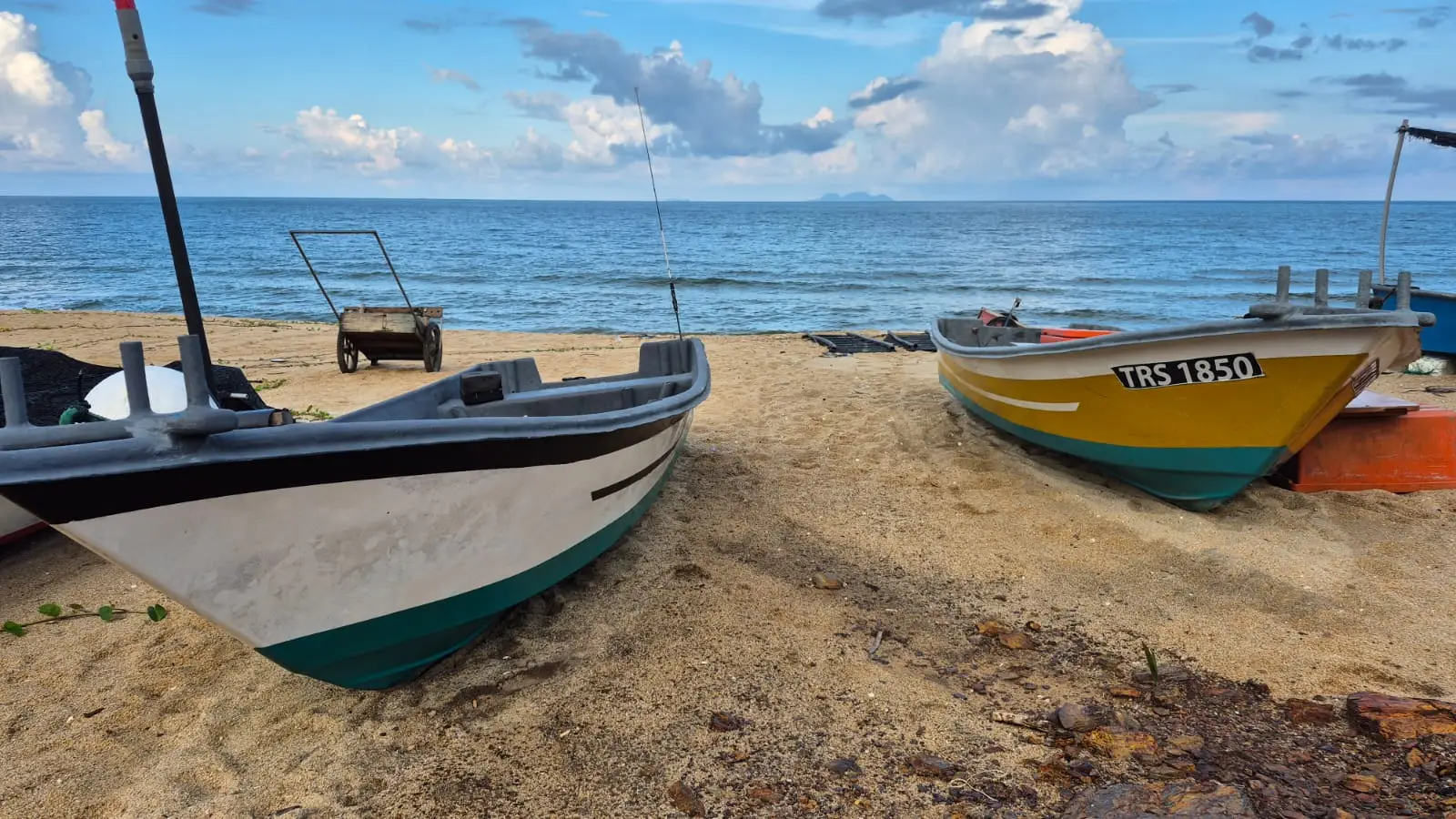
Day 2 - 4: Johor Bahru
I had originally planned to stay in Singapore for two days, but because the Formula 1 Grand Prix was being held in Singapore that week, hotel prices had doubled. What’s more, almost all the hotels in the city are high-rise buildings. That’s not really convenient if you need to assemble and possibly repair a bicycle.
Singapore is connected to mainland Malaysia by two bridges. Across the eastern bridge lies the Malaysian city of Johor Bahru. I soon discovered that hotel prices there are much lower. In fact, for half the price of an average hotel room in Singapore, you can rent an entire house in the centre of Johor Bahru. With three bedrooms, a jacuzzi, sauna and pool table. So that’s what I did.
During transport, my hydraulic brake lost pressure. Fortunately, the next day I found a bicycle repair shop not far from my house that repaired the brake for very little money. In between, I was able to do some shopping and buy a SIM card for Malaysia.
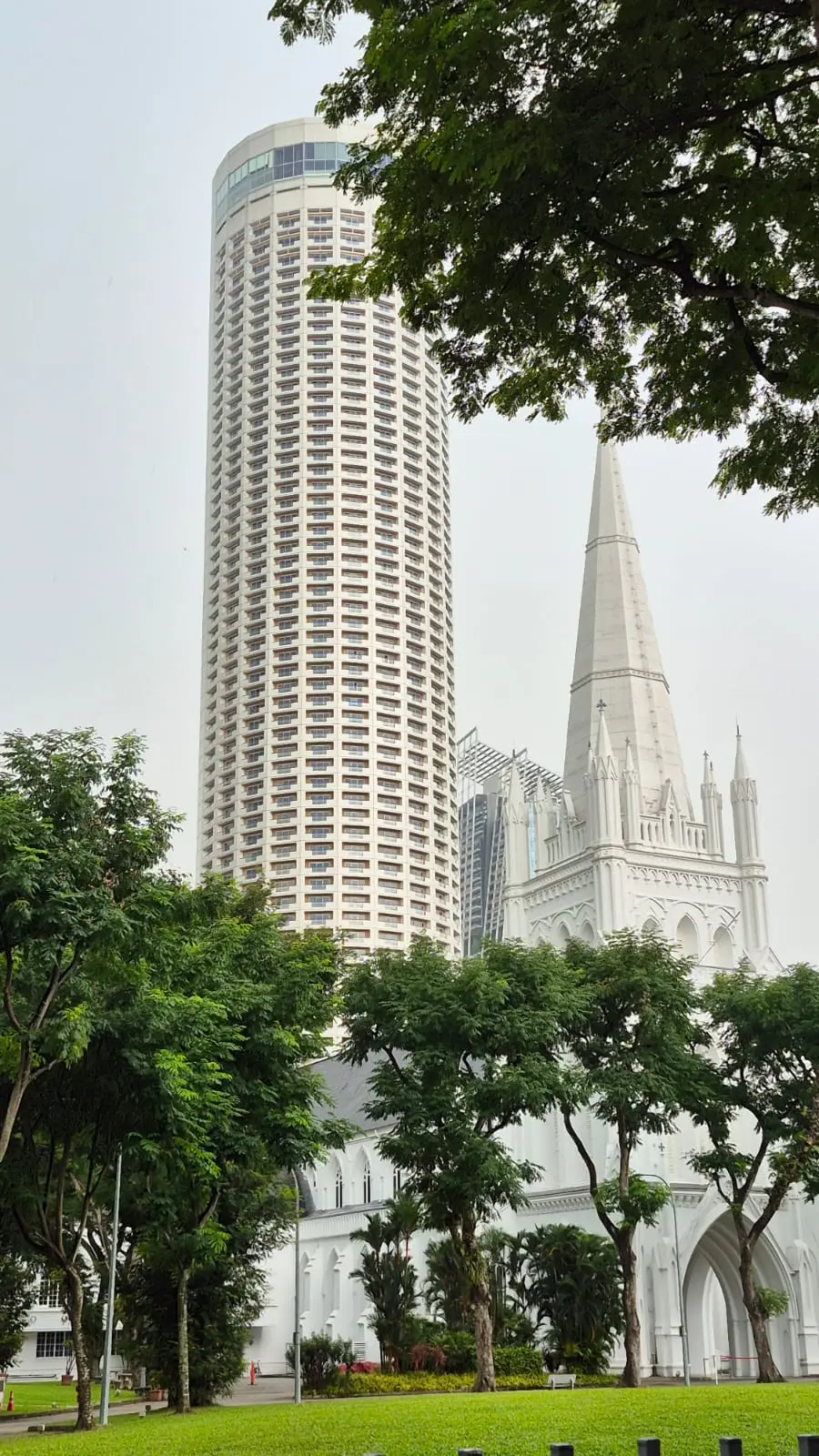
On day 3, a visit to Singapore is on the agenda. Many Malaysians from Johor Bahru work in Singapore, which means you can get there fairly quickly by bus. Once there, I discover that my Dutch internet credit has run out, and my Malaysian subscription isn’t working either. So I have to resort to the old-fashioned method of asking for directions. Fortunately, everyone is very helpful.
Singapore is small, so they build upwards. Somewhere among all those concrete blocks, I found the bicycle shop that sells the Giro helmet I want. Then I go to the centre to see the city. There is undoubtedly a lot to see in Singapore, but I’ve soon seen enough. Maybe I didn’t give the city a chance, but I don’t find it much different from other big cities that revolve around making money. Chinatown is supposed to be interesting, but since I’m going to be cycling through China for at least two months, I think I can skip that.
On Thursday, I stay at home to learn WordPress and work on my website. It’s all more difficult than I expected. At the end of the day, I still have no functioning website, and I also need to go shopping and pack. I am looking forward to cycling the next day.
Day 5: Johor Bahru – Kota Tingii 55 km
I plan to cycle along the east coast of Malaysia. To get there, I have to travel about 100 kilometres to the northeast. Halfway along that distance is Kota Tingii, where there is a campsite. That will be my destination for what feels like my first real day of cycling. My journey has begun!
To get to Kota Tingii, I first have to leave Johor Bahru. And that’s tricky. In Europe, you can easily cross a city from neighbourhood to neighbourhood. In Malaysia, it’s different. The different neighbourhoods are like “islands” connected by motorways. So to get from one side of the city to the other, you have no choice but to cycle on the motorway. And those are busy and large. Often four lanes side by side. And if you are unlucky enough to have to turn right, you have to cross two lanes to get into the correct lane. They drive on the left here. It takes me almost three hours to get out of the city.
Once I leave the city behind, the traffic calms down. Apart from a few nasty climbs, cycling becomes easier. But it’s hot. Very hot. Here, you don’t sweat, you pour with the slightest effort. Later, I hear from Malaysians that it has become warmer in recent years. What’s more, it now rains all year round. And when it rains here, it really rains.
I usually cycle between 80 and 120 kilometres a day. I’m glad I decided not to cycle all the way to the east coast. 55 kilometres was more than enough for a first day. It also gives me a little more time to get used to my first night camping in the jungle. I haven’t seen any scary animals yet.
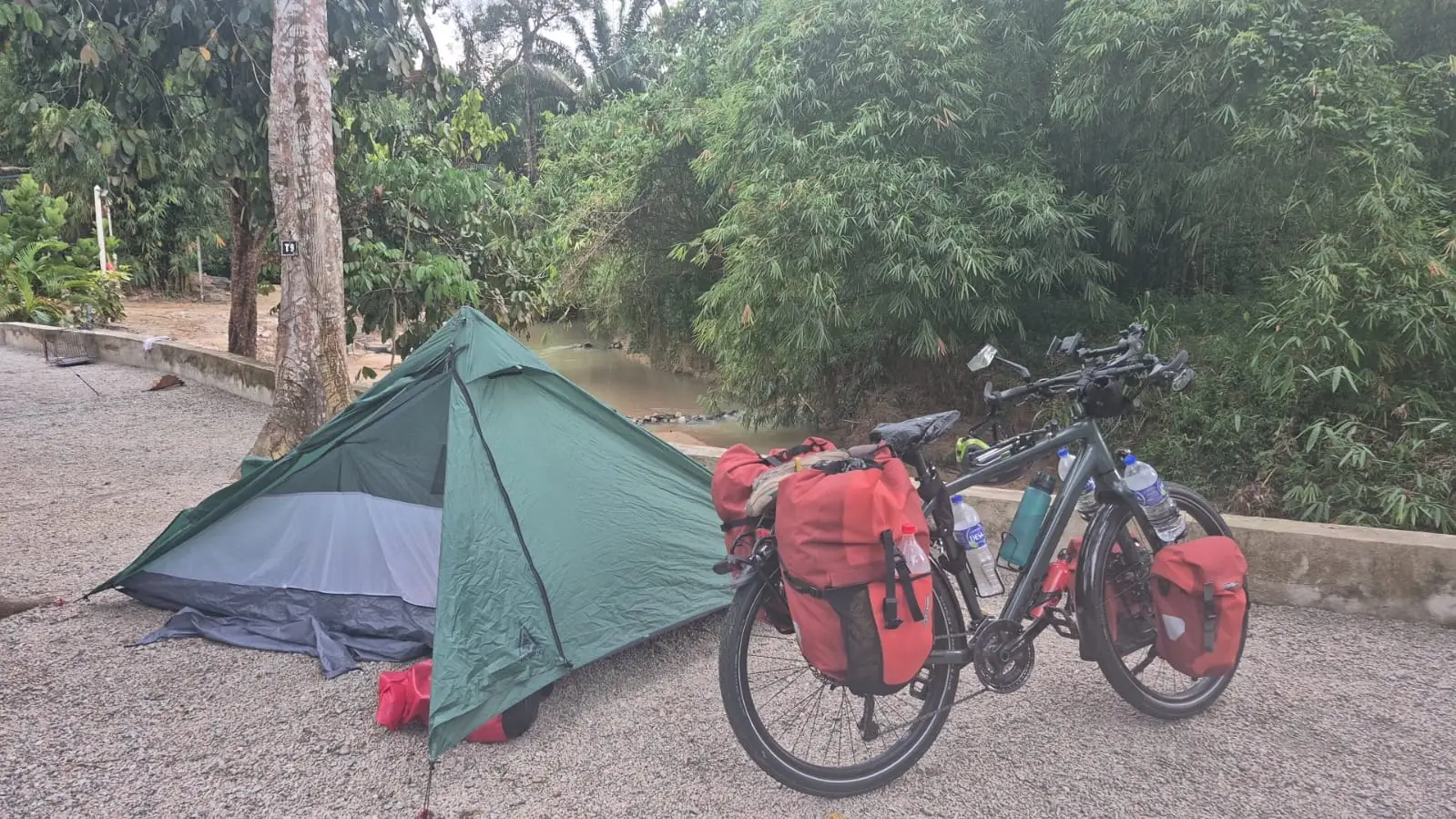
Day 6: Kota Tingii – Kambau 50 km
Sleeping in my tent in the jungle was not as bad as I had expected. I was afraid it would be very hot, but after a heavy thunderstorm it cooled down to a comfortable 25 degrees. I was lulled to sleep by the deafening noise of crickets and birds. Across the river, I occasionally heard the rustling of monkeys in the trees.
My destination for today is Kingfisher campsite on the South China Sea. It’s only 50 kilometres away. Until I get used to the weather and traffic here, I’ll take it easy. Just before I reach the sea, I see my first monkeys. A family of macaques is sitting on the side of the road, staring at me unabashedly. A little further on, a monitor lizard almost 2 metres long crosses the road right in front of me. Although I know they are harmless, it gives me a fright.
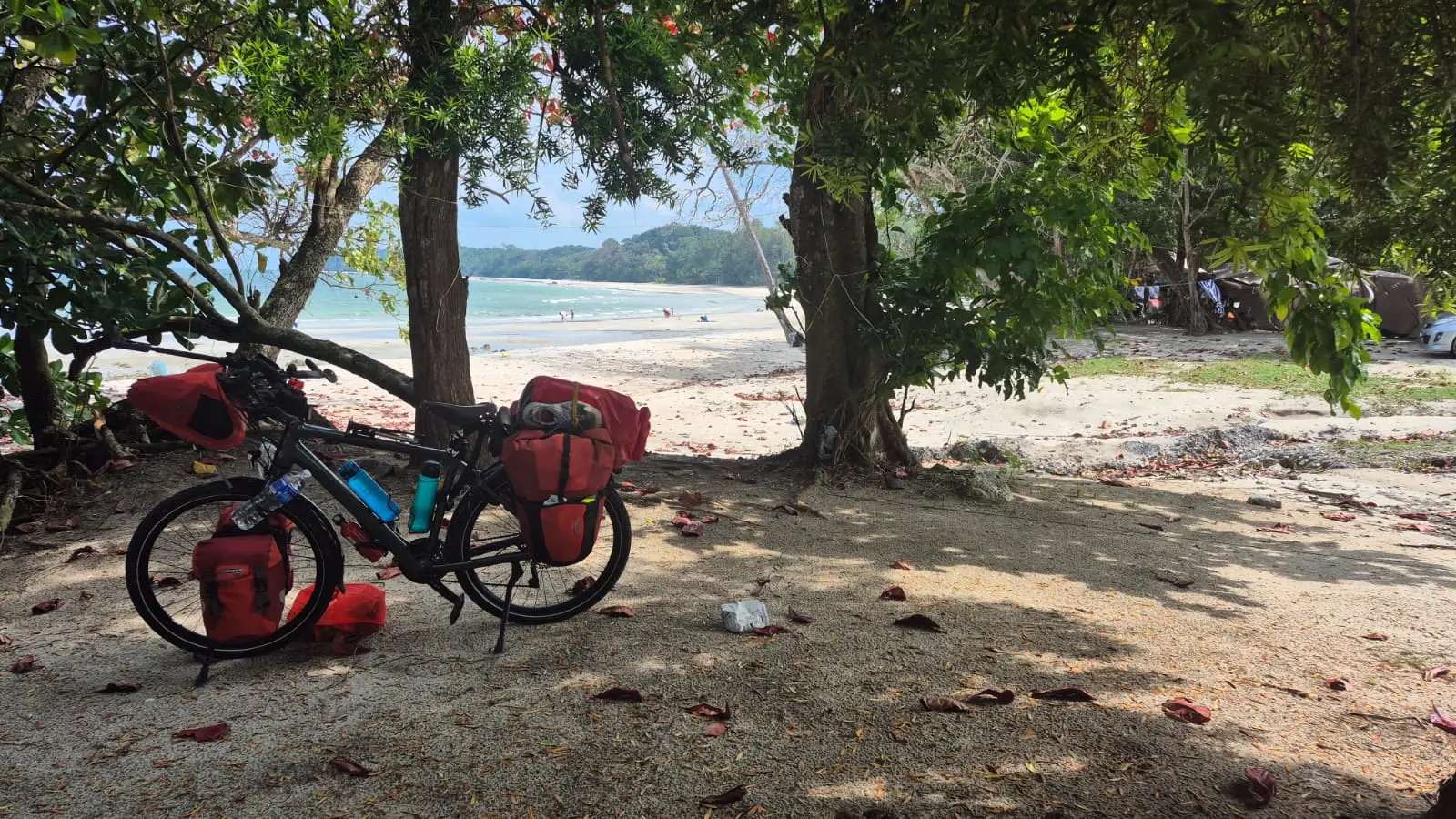
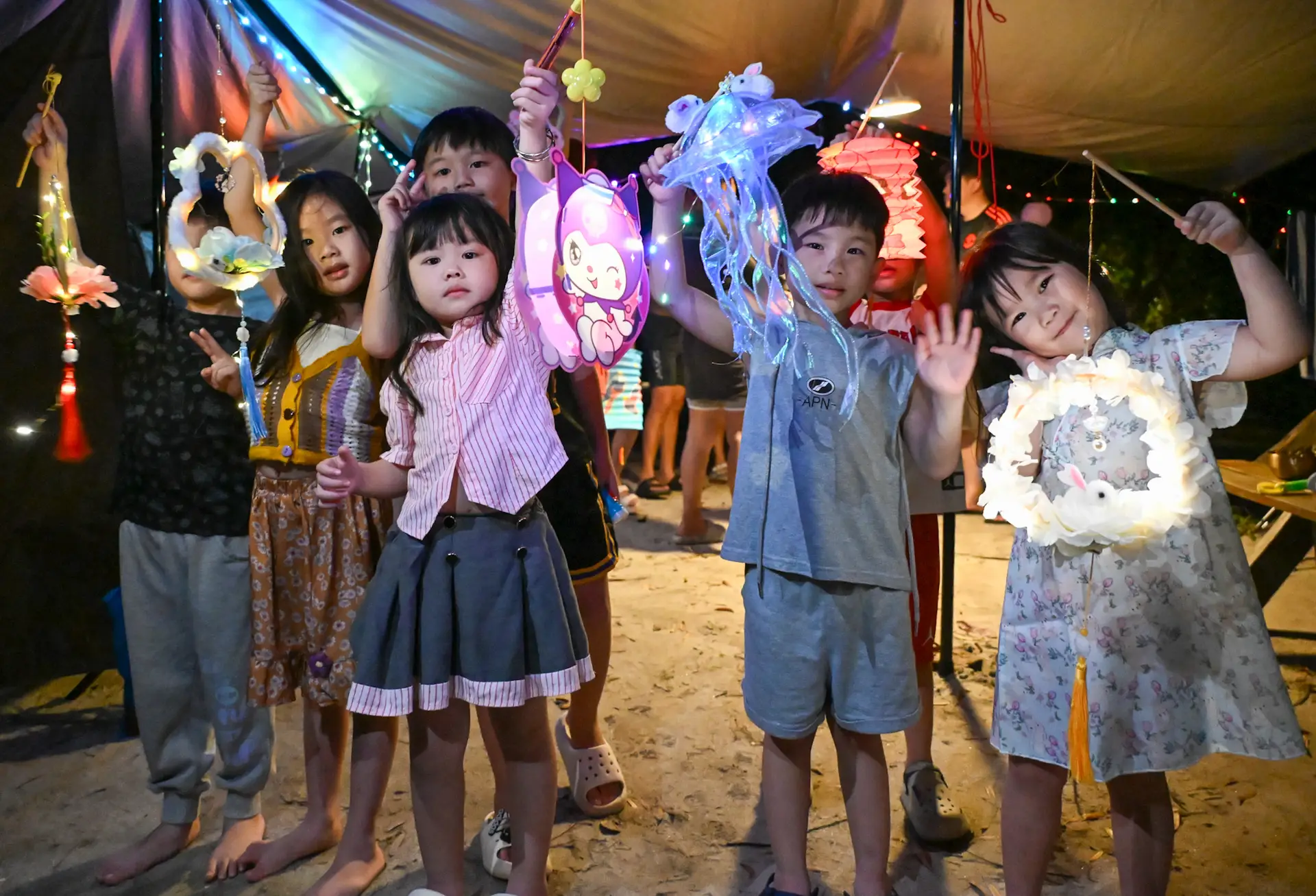
Once I arrive at the campsite, the owner, Mister Ali, is so impressed by my undertaking that he lets me stay for free. He also invites me for dinner. I am practically camping on the beach. The sea is shallow and wonderfully warm. In the evening, the Chinese children (and their parents) celebrate the Mid-Autumn Festival and walk around the campsite with colourful lanterns.
Day 7: Kambau – Tenggaroh 40 km
Just before I leave at half past eight in the morning, Mister Ali and one of his Chinese guests warn me about the stretch ahead. It passes through a tiger reserve and there are apparently wild elephants there. Great. The year before I left, I had several dreams about being eaten by tigers. And for me, tigers, along with polar bears, are without doubt the scariest mammals in existence.
But it’s not the tigers or the elephants that break me. It’s the hills and the heat. In Europe, roads lead you through valleys; not in Malaysia. Although none of the hills are higher than about seventy metres, the road goes over every peak and through every valley. A descent of more than 10 per cent is invariably followed by a climb of more than 10 per cent.
And that means I always have to go downhill as fast as possible to start the climb at the highest possible speed. Yet that is usually not enough. My bicycle and luggage together weigh just over 40 kilos, and I almost always have to get off and push the bicycle up the last few metres of the climb.
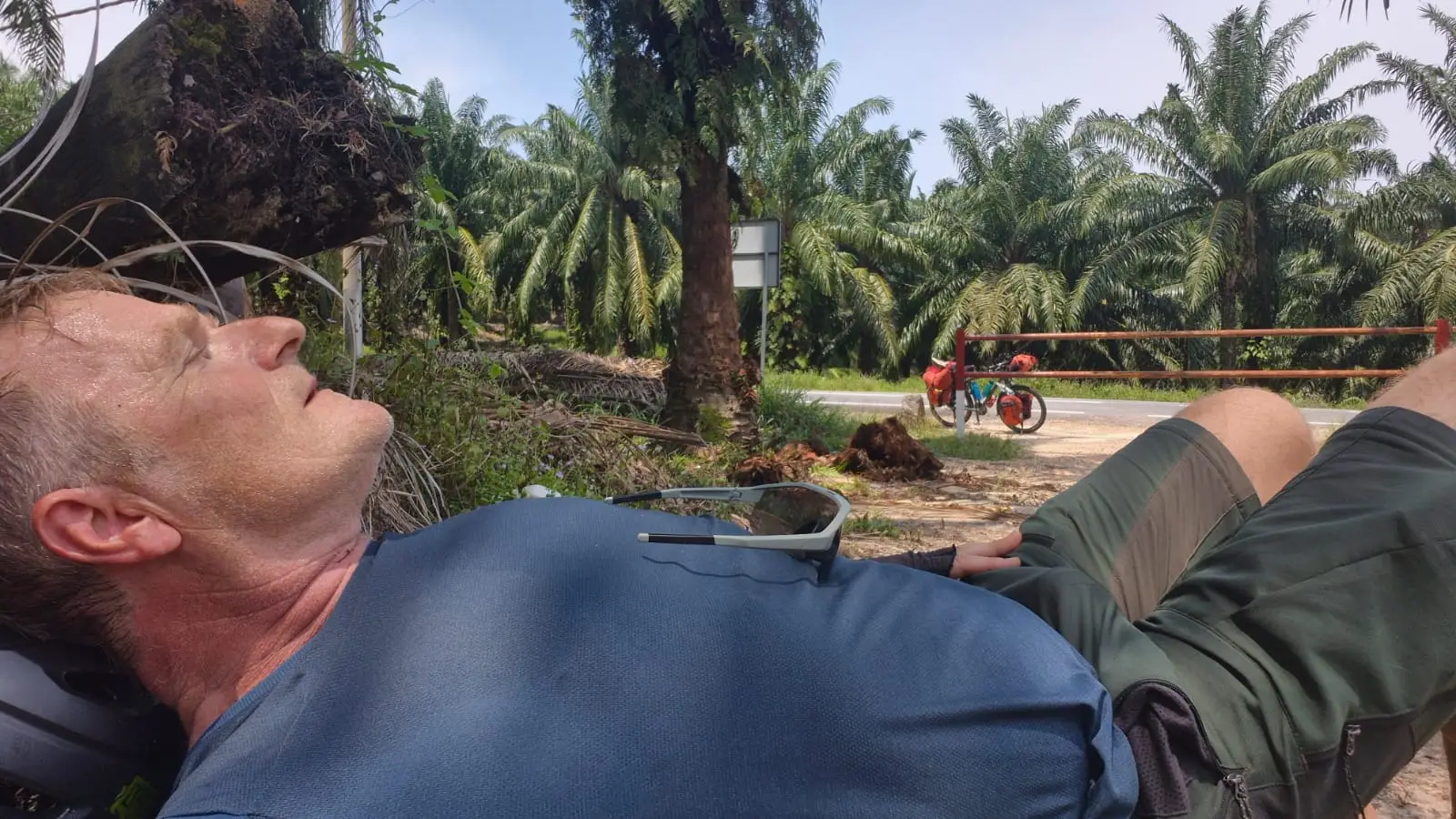
But it’s not the tigers or the elephants that break me. It’s the hills and the heat. In Europe, roads lead you through valleys; not in Malaysia. Although none of the hills are higher than about seventy metres, the road goes over every peak and through every valley. A descent of more than 10 per cent is invariably followed by a climb of more than 10 per cent.
And that means I always have to go downhill as fast as possible to start the climb at the highest possible speed. Yet that is usually not enough. My bicycle and luggage together weigh just over 40 kilos, and I almost always have to get off and push the bicycle up the last few metres of the climb.
And it’s hot. By mid-morning, it’s already 35 degrees with 90 per cent humidity. At noon, after 25 kilometres, I’m overheated. I take a break at a petrol station and decide that I can’t make it the remaining 60 kilometres to Mersing. According to Google, my only option is a resort 17 kilometres away in the other direction. So be it.
Days 8, 9 and 10: Tenggaroh
There is not much to report about the three days I was in Tenggaroh. I spent most of my time in my air-conditioned room finishing my website and getting to know my cameras better. Occasionally, I went for a swim in the pool or a walk along the beach.
I am concerned about my failed attempt to reach Mersing. Is my plan perhaps a little too ambitious for a 61-year-old? If small hills are already so difficult for me, what will it be like when I really go into the mountains? But I console myself with the thought that by then it will be cooler, and I will be fitter and lighter. Nevertheless, I am dreading the next stage. I know that at least the first 17 kilometres will be tough.
Day 11: Tenggaroh – Tenglu 79 km
At 7 o’clock in the morning, I am the first one in the restaurant. I had planned to leave earlier, but it seems wise to fill my stomach first. As always, there are 40 types of nasi on the menu. Fortunately, there are also fried eggs, toast and sausages. I eat everything as quickly as possible and then set off.
The first 17 kilometres are up and down again. But it’s all a lot easier for me now. Partly because I’m still fit, but I also think it’s because I had imagined it all to be a lot worse. After an hour, I’m back at the petrol station. I stop for a cold orange juice and then continue on my way. Not much later, I leave the hills behind me. It wasn’t so bad after all. From now on, it’s all flat.
Day 12: Tenglu – Endau 59 km
Day 13: Endau -Pekan 91 km
Day 14: Pekan – Kuantan 56 km
Day 15: Kuantan
Day 16: Kuantan – Kemasik 80 km
Day 17: Kemasik – Sura 44 km
Day 18: Sura – Kuala Dungun 75 km
Day 19: Kuala Dungun
Day 20: Kuala Dungun – Kuala Ibai 71 km
Day 21: Kuala Ibai – Tembila 88 km
Day 22: Tembila – Kota Bahru 82 km
I am sitting next to the swimming pool at Captain’s Cabin Resort in Kampung Banggor, near Kota Bahru, the last major city on the east coast of Malaysia, about 20 kilometres from the Thai border.
From now on, I need to take some time every evening to work on this diary. As the days go by, I am losing track of what happened when. The last few days of the trip were largely the same, without any real highs or lows. Interchangeable. That is why I am summarising the last 10 days in one text.
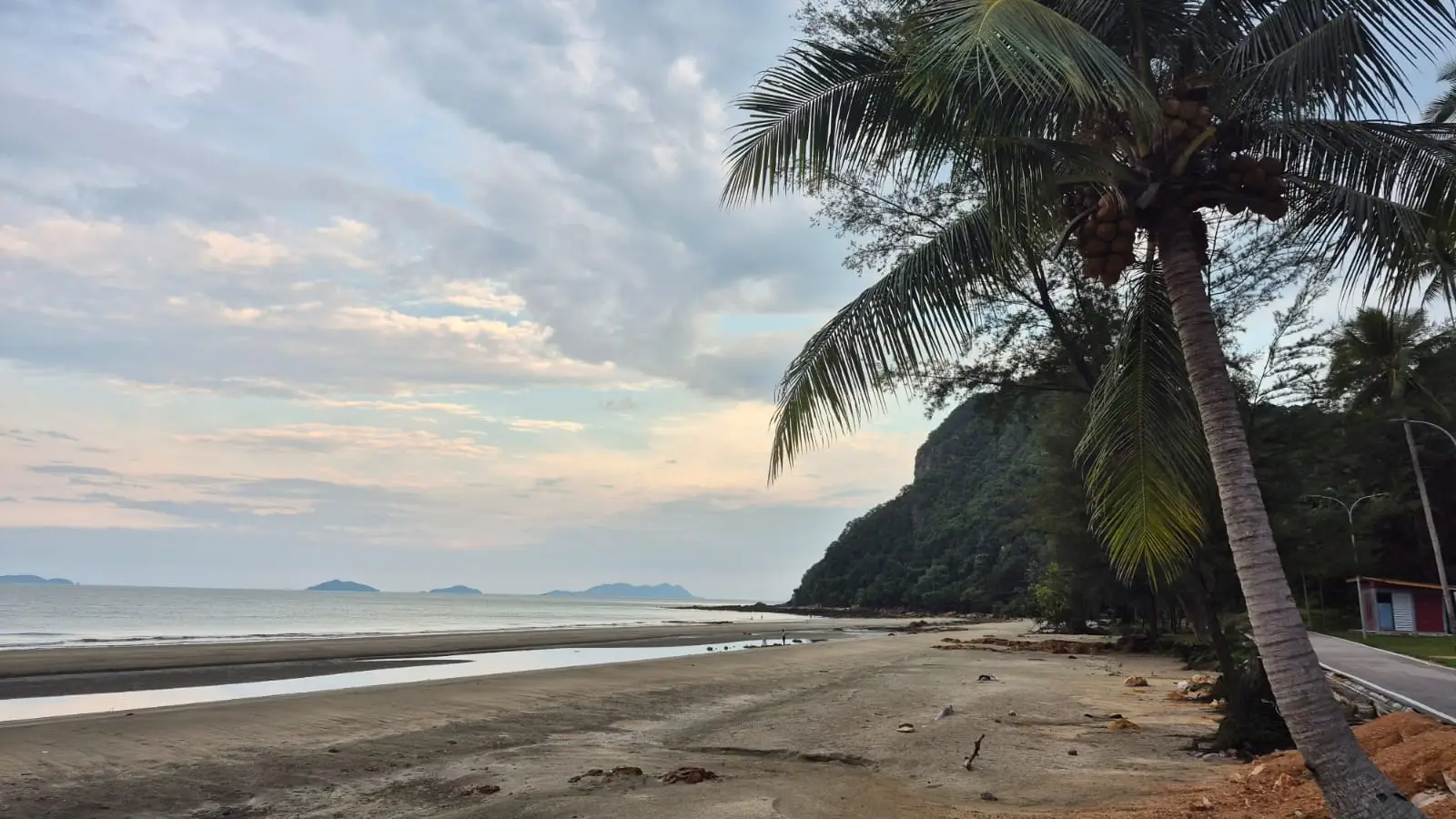
Once I had left the hills behind me, the landscape changed too. I drove through a wide, flat coastal strip and could only see mountains and hills in the distance, to the west. I spent most of my time driving north on Highway 3. The road follows the coast and runs mostly through palm oil plantations.
As I progressed, the wild animals also disappeared. Soon there were no more monkeys to be seen, nor any monitor lizards. Monitor lizards are huge monitor lizards measuring 1.5 to 2 metres in length. They gave me quite a few scares when they crossed the road right in front of my bicycle. But I know they are useful, harmless animals. They would rather eat a rat or a cat than a European.
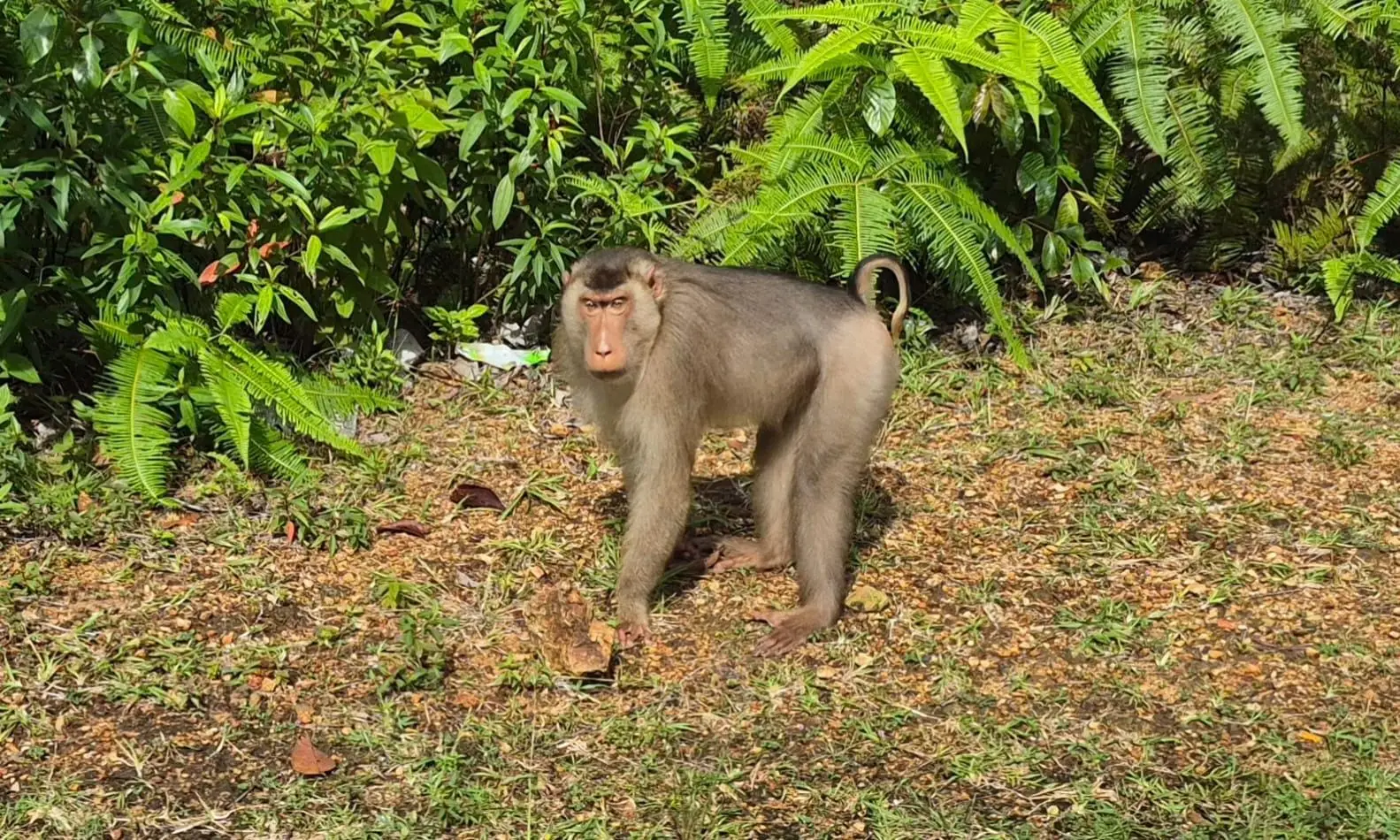
Most of the animals I saw were on the street. Run over. Dogs, cats, monkeys, monitor lizards and even the odd tapir. No elephants, Malaysians don’t dare to do that. Looking at the large number of dead snakes, you get the feeling that running over snakes is a national sport. Without exception, they are all lying on the hard shoulder, whereas statistically they should be scattered across the entire road. ‘Look Jahid, there’s another one trying to cross. That one has your name on it!
Just outside the kampongs, scattered along the side of the road, are a kind of market stalls. There, people prepare nasi, satay and roast chicken for travellers. Fruit and drinks are also sold. Large jugs of tasty fruit juice and coconut drinks. Chilled with ice, so unfortunately not for me. No matter how hot I am. I stop at petrol stations to buy cans of soft drinks and bottles of water.
Every few metres, I am hit by the smell of rotting meat, sweaty socks and broken sewers. These are the stalls where durian fruit is sold. In Singapore, it is forbidden to take this fruit on public transport. I haven’t tasted it yet, but I definitely plan to.
It is still hot, and the humidity is high. Although the monsoon has not yet started, it rains heavily from time to time. At first, I tried to take shelter. But I’m already soaking wet from sweating, so a little rain is refreshing and washes the salt off my body. Only when it rains so hard that visibility becomes really poor do I stop for a while. During and immediately after rain showers, you hear the most ambulances.
I camp or spend the night in cheap homestays. A homestay is a kind of bed and breakfast, but without breakfast. They are often shipping containers with a window and door cut into them. They have a bed, a rudimentary bathroom and air conditioning. I don’t need much more than that. As long as I can shower and it’s clean and cool. When I stay somewhere for a day or two, I try to find a slightly better place to stay. A little luxury now and then doesn’t hurt. Although luxury is sometimes a relative concept here..
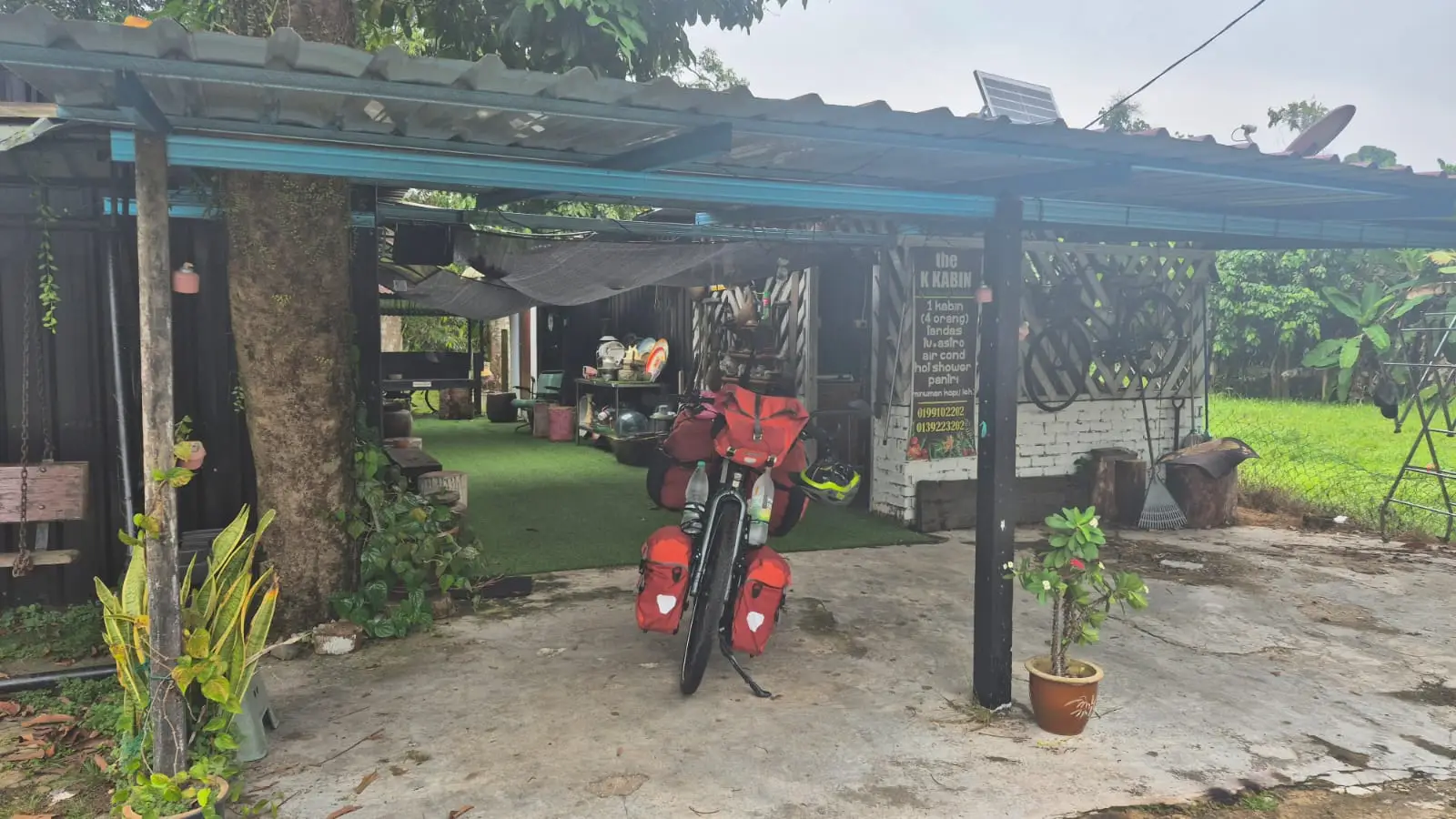
You don’t see foreigners here. In the past few weeks, I’ve seen exactly three. That, and my impressive bicycle, make me something of an attraction. I think I was the most photographed person in Malaysia last month. Cars slow down, after which the drivers or passengers perform the most daring antics to get a good picture. Sometimes I am stopped on the street for a selfie, and I am offered food as a reward.
Everyone also greets me. That’s nice and makes you feel welcome. But when you cycle along a major road all day and one in three cars and motorbikes honk at you, it does get on your nerves after a while. I keep smiling amiably and calling back hello. Waving quickly becomes tiring.
Days 23, 24, 25 and 26: Kampung Banggor
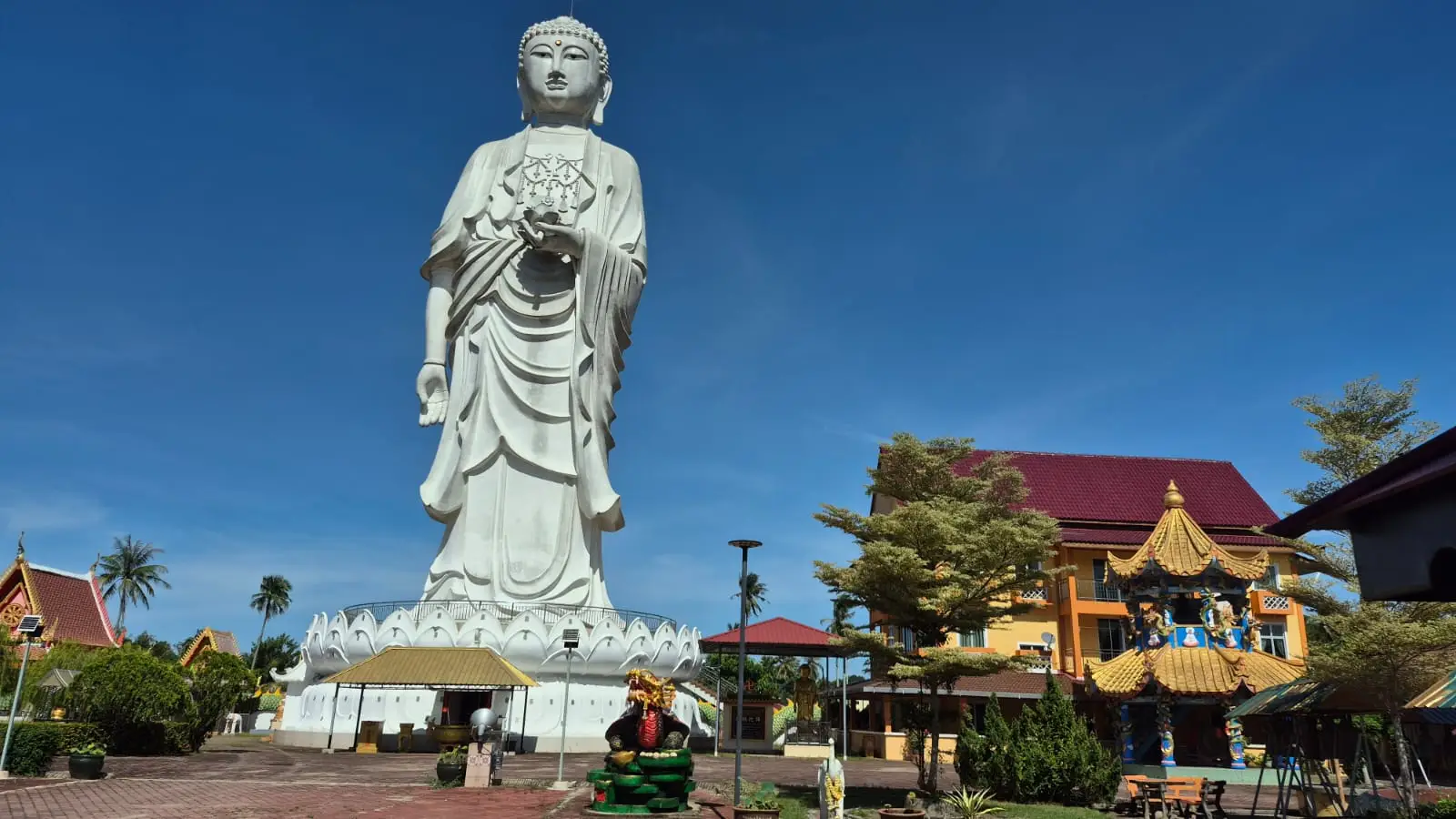
When I arrive at Captain’s Cabin Resort, I am exhausted. Although I have only cycled a little over 80 kilometres, it has been a very tough day. Not only was it extremely hot, but the road had hardly any hard shoulder. That meant I had to be on my toes all day to avoid being run off the road. The only welcome break was a stop at a Buddhist temple complex in Wat Phothikyan Phutthaktham. I didn’t know it existed, but the towering statue of the Buddha was hard to miss.
In Malaysia, the names of hotels and homestays sometimes don’t quite live up to expectations. A few days ago, I stayed at Sand Dune Villas. There was plenty of sand, but the villas turned out to be a bunch of grubby shipping containers scattered around the grounds.
Captain’s Cabin Resort is not a resort as we Europeans know it. There is no subtropical swimming paradise, and no entertainment with the obligatory karaoke evenings. Captain’s Cabin Resort is a country house with a large swimming pool. Located in a quiet kampong, where apart from the call to prayer a few times a day, all you can hear are birds, crickets and the splashing of water from the stream behind the house. An oasis of tranquillity.
When the captain and his wife see how I am, they immediately upgrade my room to their suite on the ground floor. That way, I can park my bicycle in front of the patio door and don’t have to lug my bags up the stairs. They say I deserve it.
After showering, there is a knock at the door. The captain is standing at the patio door with a plate of fried noodles in his hand. Just what I need! A moment later, there is another knock and it is his wife with a bowl of homemade trifle.
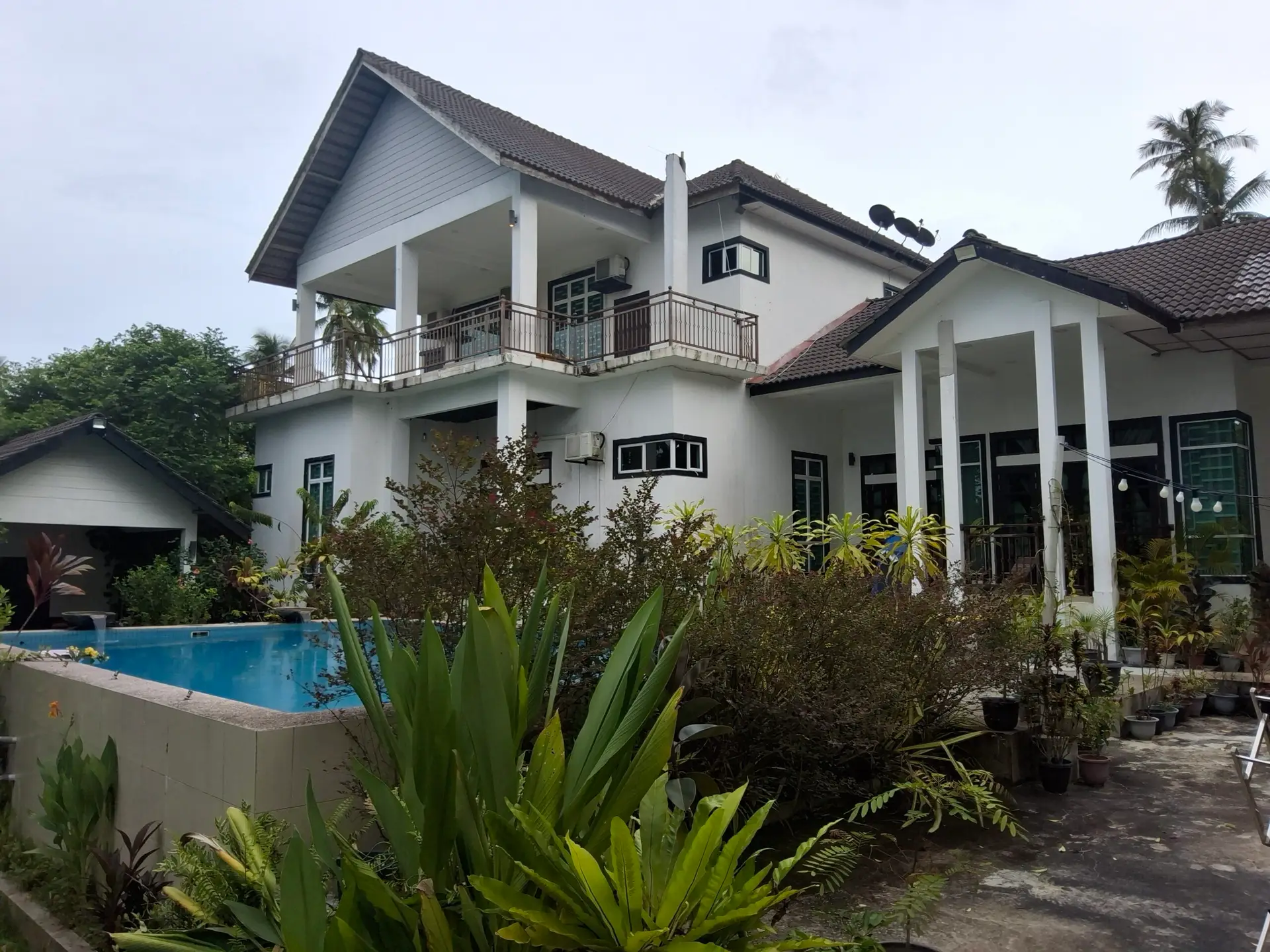
This is typical of the hospitality here. It is a poor area. The people are not well off, but they are willing to share what little they have with you. The captain has a small pension from the Malaysian navy, but otherwise has to rely on the income from his hotel. In the Netherlands, it would be constantly fully booked. But the reality here in Malaysia is different. Rarely are more than one or two rooms occupied. And when a foreign tourist does come, a disproportionate amount of the room’s revenue disappears into the deep pockets of booking.com.
I originally planned to stay here for two days to rest and prepare for the next leg of my journey through Thailand. In the end, I stay for four days as a guest of the family. We eat together and I learn a lot about life here. About what keeps people busy and makes them happy. I feel at home and would have liked to stay longer.
I cycled about 900 kilometres through Malaysia. I saw beautiful beaches and the jungle. But there are hardly any tourist attractions. The cities are unattractive. You won’t find any cathedrals, castles or historic city centres here. But I’ve already been to hundreds of cathedrals and seen plenty of castles. For me, the essence of travelling is the journey and the people I meet. And in that respect, Malaysia was more than worth it. Tomorrow, Thailand.